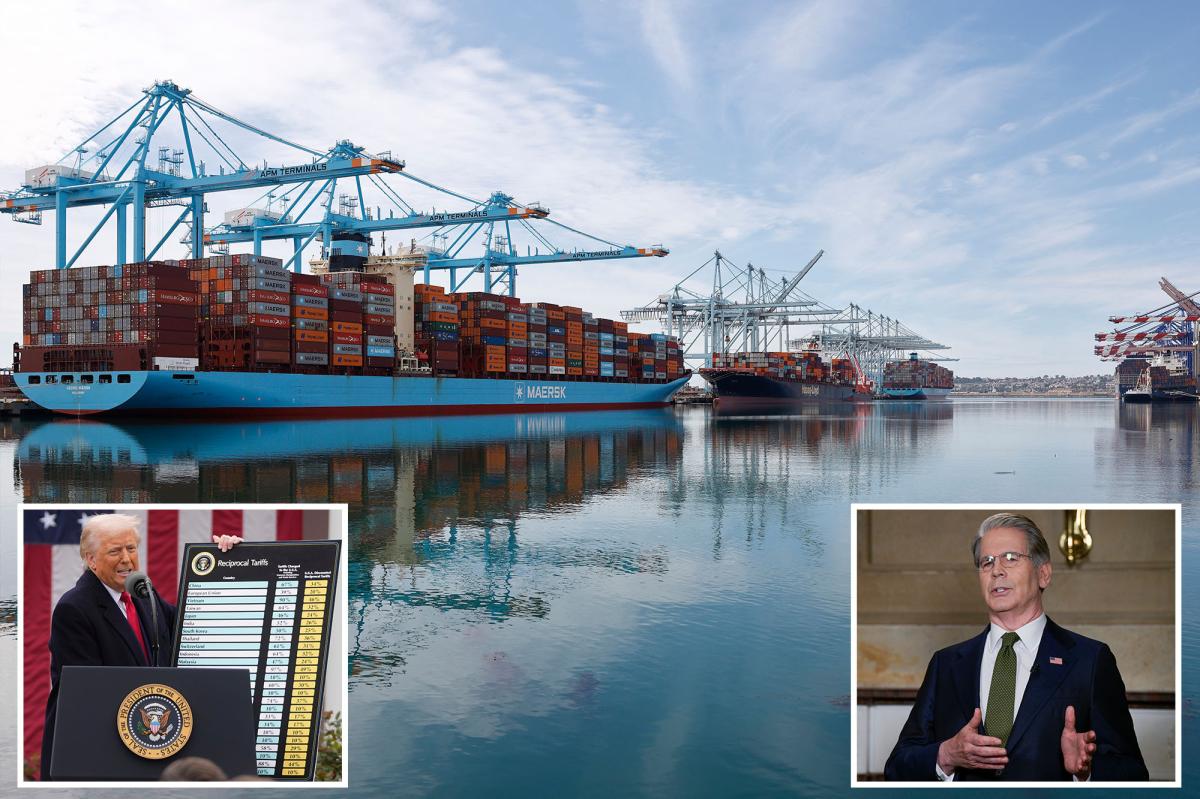
President Donald Trump's recently announced 15% global tariff will likely be implemented sometime this week, rising from its current rate of 10%, Treasury Secretary Scott Bessent said on Wednesday. Bessent also predicted that U.S. tariff rates would, by August, effectively return to where they stood before the Supreme Court recently struck down the often-steeper duties that Trump unilaterally imposed on most of the world's countries last year.
Federal Reserve Governor Stephen Miran says it's still appropriate to cut interest rates despite the war with Iran. He speaks on Bloomberg Surveillance.
February's jobs data. The Bureau of Labor Statistics' latest report on Friday is expected to show a slowdown in added jobs to 60,000, down from 130,000, and for the unemployment rate to settle at 4.3%.
Oppenheimer analyst Chris Kotowski says Blue Owl has become ‘a magnet for bad press.'
Brian Levitt, Chief Global Market Strategist at Invesco reveals which pullbacks are worth buying now and why cyclical sectors, mid‑caps, and non‑U.S. markets may lead the next move higher. 00:00 Introduction 00:10 New Highs Outlook 00:41 Return Expectations This Year 01:09 Fundamentals Behind the Rally 02:31 Tech Underperformance Outlook 03:25 Buying the SaaS Pullback 04:05 Magnificent Seven Outlook 05:19 Where to Put Money to Work 06:15 Non-U.S. Opportunities 06:53 Preferred Sectors 07:41 Dow vs.
The US aerospace and defense industry faces incremental, not transformative, growth opportunities from recent Middle East conflicts, with upside capped by supply constraints. Missile defense and counter-drone solutions see increased demand, but near-term growth is limited by production capacity rather than new orders.
Market leadership broadened in 2025, and this has continued in 2026, with emerging markets and some developed markets outperforming the United States. Asset-heavy sectors dominate, reflecting that AI infrastructure and national-security spending are driving a multiyear global capex cycle in data centers, power, defense, and supply chains.
Despite Middle East turmoil and surging oil, the S&P 500 showed resilience, narrowing steep losses as earnings momentum remains strong. Oil prices, though elevated, are not near recession-triggering levels; historical context suggests current levels are manageable for markets.
Treasury Secretary Scott Bessent said President Donald Trump's new 15% global tariff will take effect this week, also predicting tariff rates will eventually return to the levels they were before the Supreme Court struck down Trump's sweeping tariff policy.
ADP's monthly report on business payrolls showed the economy added 63,000 jobs last month, versus the 11,000 seen in January. Analysts surveyed expected 48,000 new private-sector jobs.
Large language models are advancing rapidly, delivering AI agents and enabling the creation of lightweight, task-specific applications in days rather than months. Market concerns have manifested in dramatic valuation compression, with underperformance driven more by multiple contraction than actual estimate revisions.
US futures were pointing to a flat to marginally lower open on Wall Street on Wednesday, with the mood seeming to be one of slightly weary stabilisation more than any real conviction. Dow Jones futures were off around 77 points, S&P futures down 5 points and the Nasdaq barely changed, before minutes later the Nasdaq was up 0.2% and the Dow was back to flat.
The figure reported on Wednesday is below economists' estimates of an increase of 50,000 jobs and higher than the prior month's revised reading of a gain of 11,000 jobs.
ADP said businesses created 63,000 new jobs in February — the biggest increase in four months — in another sign that a sluggish U.S. labor market might be slightly perking up.
“It's my strong belief that the tariff rates will be back to their old rate within five months,” Bessent told CNBC.
The airline industry faces significant risks from the Iran conflict, primarily via higher oil prices and regional flight disruptions. Margins for major US airlines could fall from 6% to near break-even if oil prices remain elevated and costs cannot be passed to consumers.
A few weeks ago, I covered the Investors Intelligence (II) sentiment survey and noted that extreme bullishness from published stock market newsletters has historically been followed by market underperformance.
South Korea's KOSPI index crashed nearly 20% in two days, driven by energy dependency, FX weakness, and leveraged margin calls. Major tech stocks like Samsung (SSNLF) and SK Hynix (HXSC.F) suffered double-digit declines, triggering a cascade of forced selling and algorithmic trades.
Treasury Secretary Scott Bessent said President Donald Trump's recently announced 15% global tariff will be implemented this week. Bessent predicted that U.S. tariff rates will return in five months to where they stood before the Supreme Court struck down Trump's "reciprocal" duties.
During times of turbulence and uncertainty in the markets, many investors turn to dividend-yielding stocks. These are often companies that have high free cash flows and reward shareholders with a high dividend payout.
Large institutional investors are now net sellers of single-family rental homes. Dallas investors own 9.2% of the housing stock but account for 22.8% of new for-sale listings, according to research from housing data and analytics firm Parcl Labs.
I remain bullish on the economy and stock market but highlight substantial AI-driven disruption, CapEx hangover, and credit contagion risks. Capital is moving rapidly, creating a binary, stock-picker's market where AI adoption quickly distinguishes winners and losers.
Having missed the onset of a historic inflation surge just years ago, European Central Bank policymakers are likely to avoid casting any Iran war-induced price spike as "transitory" and may keep a lower bar for policy action than in past energy price shocks.
Inflation is the major risk facing global bond markets, a senior OECD official told Reuters, as energy prices surge following the U.S.-Israeli air war against Iran.
Cryptocurrency exchange Kraken's banking unit has won access to the Federal Reserve's core payment systems, the Wall Street Journal reported on Wednesday.
CNBC's Joe Kernen reports on the 5 things to know on March 4, 2026.
The overnight plunge in South Korea suggests investors can't see where the next pocket of risk will emerge.
Markets can and will get past geopolitical conflicts eventually. But the road between Point A to Point B can be volatile and financially treacherous.
Markets are influenced by a constant interplay between short‑term narratives and underlying fundamentals. Emotions are high around AI, yet earnings data and analyst earnings expectations haven't deteriorated meaningfully.
The most oversold stocks in the financial sector presents an opportunity to buy into undervalued companies.
After a relatively positive and calm start to the year in January, February proved to be much more eventful across markets and the economy. February has offered yet another stark reminder that markets and economic events are often frustratingly unpredictable, but also that maintaining a long-term view is often the most prudent approach in a world where successful market timing is next to impossible.
The decision means the industry is a step closer to becoming integrated into the mainstream financial system.
Recent U.S. and Israeli strikes in Iran mark a significant escalation in the Middle East conflict, raising the risk of broader regional spillovers with global market consequences. The dominant economic risk centers on potential disruption to the Strait of Hormuz, a critical maritime chokepoint along Iran's southern coast.
Inflation worries have pushed the 10-year Treasury yield back above 4%.
Ships wanting to pass through the Strait of Hormuz are finding it almost impossible to buy hull war cover following the conflict between Iran and the US and Israel. The Strait, a narrow stretch of water connecting the Persian Gulf and the Gulf of Oman, is a key shipping lane through which roughly 20% of the world's seaborne oil and gas is transported.
The US and Israel on Feb. 28 launched a large-scale, coordinated air campaign against Iran, striking a broad range of leadership, military, security and nuclear targets. Global supply networks may feel the impact through a mixture of energy market disruptions, airfreight challenges and container freight shipping network interruptions.
The CNN Money Fear and Greed index showed an increase in the overall fear level, while the index remained in the “Fear” zone on Tuesday.
Consumers are embracing instant payments, which offer them speed, security and peace of mind that their money is exactly where it needs to be, when it needs to be. Corporates, however, are slower to make the jump.
UAE stock exchanges reopened Wednesday, after being closed for two days in the wake of a wave of Iranian missile and drone strikes on the Gulf nation. Stocks listed in Dubai and Abu Dhabi sold off as trading resumed.
Avenue Capital Group CEO Marc Lasry discusses the state of the stock market given the United States' conflict with Iran on ‘The Claman Countdown.' #fox #media #breakingnews #us #usa #new #news #breaking #foxbusiness #theclamancountdown #finance #markets #investing #economy #marclasry #avenuecapital #stockmarket #iranconflict #volatility #investmentadvice #economicoutlook
The Swiss National Bank has struggled to limit the appreciation of the franc over the last year.
Osaic chief market strategist Phil Blancato assesses key factors driving market action on 'Making Money.' #fox #media #breakingnews #us #usa #new #news #breaking #foxbusiness #makingmoney #stocks #stockmarket #investing #investment #finance #economy #markets #wallstreet #investors #volatility #trading #business #money #global #analysis
European stocks are expected to open in mixed territory on Wednesday as markets continue to track developments in the Middle East.
MongoDB CEO CJ Desai discusses the company's market performance on 'The Claman Countdown.'#fox #media #breakingnews #us #usa #new #news #breaking #foxbusiness #theclamancountdown #business #markets #stocks #investing #economy #technology #tech #leadership #ceo #earnings #finance #wallstreet #growth #innovation #investors #trading
There is no shortage of commentary surrounding the current conflict involving the United States, Israel, and Iran. The single most critical variable in the current situation is the Strait of Hormuz - a narrow but strategically vital waterway that represents one of the most important shipping chokepoints in the global economy.
On Tuesday morning, energy prices are trading sharply higher once again as investors begin to fear a more prolonged conflict in the Middle East. Stock markets around the world are trading sharply lower once again on Tuesday.
Coming into 2026, most asset markets were exhibiting excessive optimism - pricing the best of all possible outcomes. Canada's TSX index has a very small tech sector, and yet, the ‘risk-on' Canadian stock market leapt with tech-soaked US markets into 2026.
Goldman Sachs CEO David Solomon said on Wednesday that he was surprised at the "benign" reaction in financial markets over the conflict in the Middle East, and it may take a "couple of weeks" for investors to more fully digest the impacts.