Large Payroll Drop In February Weakens Jobs Outlook but Paves Way for Fed Rate Cut
Payrolls dropped by a whopping 92,000 in February, confounding economists' views that the job market was starting to gain strength.
Global economic updates, market sentiment, and financial headlines.

When global headlines turn alarming, investors often feel an urge to overhaul their portfolios, but that instinct is usually the wrong one. Markets tend to recover far faster than our emotions do, even during periods of geopolitical tension.

Payrolls dropped by a whopping 92,000 in February, confounding economists' views that the job market was starting to gain strength.

San Francisco Federal Reserve President Mary Daly said Friday the weak February jobs report adds to a difficult policymaking environment. In a CNBC interview, Daly did not commit to a position on interest rates, but said a softening labor market combined with inflation still running above the central bank's 2% target complicate future decisions

Oil prices surged to multiyear highs Friday as the Iran conflict tightened global supplies. Refiners and U.S. and Canadian producers rallied.

Employers shed 92K jobs in February, the Labor Department reported Friday. The losses were a significant miss against the 50K job gains that were expected.

The U.S. economy lost jobs in February, the Bureau of Labor Statistics reported Friday. Nonfarm payrolls fell by 92,000 for the month, compared to the estimate for 50,000 and below the downwardly revised January total of 126,000.

Markets need an improvement in Trump's poll ratings, one strategist says.

This is a developing story.

Nonfarm payrolls dropped by 92,000, analysts expected a gain of 55,000. The unemployment rate climbed to 4.4%.

Sales at retailers declined in January, the Commerce Department said, extending a tepid trend for U.S. shopping since late last year.

The U.S. economy lost 92,000 jobs in February, while the unemployment rate rose to 4.4%, in a report that was weaker than expected.

The US economy lost 92,000 jobs in a shocking February jobs report.

Hiring in February was surprisingly weak, signaling the labor market might not be as stable as Federal Reserve officials hoped – further thwarting the path to interest-rate cuts as the conflict in Iran reheats inflation fears.

As of March 6, 2026, two stocks in the information technology sector could be flashing a real warning to investors who value momentum as a key criteria in their trading decisions.

The U.S. economy shed jobs to start the year, as the Labor Department reported that employment decreased by 92,000 jobs in February 2026, when economists expected a gain of 59,000.

The unemployment rate was 4.4% in February, with 130,000 jobs added in January

The U.S. lost 92,000 jobs in February, the Labor Department said Friday, missing expectations.

Nonfarm payrolls were expected to increase 50,000 in February while the unemployment rate held steady at 4.3%.

Federal Reserve Governor Christopher Waller discusses the potential inflationary impact of war with Iran, US payrolls, ongoing risks from tariffs, and his view of private credit markets on “Bloomberg Surveillance.” -------- More on Bloomberg Television and Markets Like this video?

The February jobs report showed payrolls unexpectedly fell by 92,000. S&P 500 futures added to losses.

8am: Nasdaq set to lead Wall Street decline US futures pointed to a weaker start on Wall Street on Friday as the conflict in the Middle East entered its seventh day and investors braced for the latest US jobs report. Nasdaq futures were down 0.9%, while futures for the S&P 500 and the Dow Jones slipped 0.6%.

Whether stocks are surging or sliding, you should always have exposure to low-priced names. But you still need a game plan.

During times of turbulence and uncertainty in the markets, many investors turn to dividend-yielding stocks. These are often companies that have high free cash flows and reward shareholders with a high dividend payout.

The S&P 500's recent downswing has caught many investors off guard. And some stocks are getting absolutely pounded.

The Rule of 20 has lost effectiveness post-2020, consistently signaling S&P 500 overvaluation amid a terrific bull run. The current R20 score for the SP500 is 32.2, far above the traditional 20 threshold, yet I see continued upside potential due to structural shifts.

A year ago, Anthropic was a niche artificial-intelligence lab in the shadow of OpenAI. Now, Anthropic's Claude sits at the top of the App store in 16 different countries.

Employment data for February will be released by the Labor Department on Friday.

Everything Mike Dolan and the ROI team are excited to read, watch and listen to over the weekend.

The most oversold stocks in the industrials sector presents an opportunity to buy into undervalued companies.

The conflict has upended long-held assumptions in Gulf markets, pushing investors to factor in new dangers.

Economists say estimates from the Bureau of Labor Statistics and other agencies are reliable, but they worry the quality of data is eroding.

The feasibility and efficacy of President Donald Trump's plan to backstop marine insurers covering shipping in the Persian Gulf is being questioned as the war between the US and Israel and Iran continues. Trump announced on his Truth Social platform on March 3 that he had ordered the US International Development Finance Corporation to extend political risk insurance and guarantees at a very reasonable price to secure maritime trade on its transit through the Gulf.

Oil shock drove the sell-off: Since the start of the US-Iran War, Japan's Nikkei 225 fell 6.1% in four days, underperforming global peers as Japan's heavy reliance on imported oil heightens stagflation risks. Yield curve shift may support equities: A bull steepening of the Japanese government bond yield curve (10-yr minus 2-yr), partly driven by expectations of a less hawkish Bank of Japan, historically correlates with upside momentum in the Nikkei and may support a short-term rebound.

Why the Iran conflict is unlikely to be brief. What is the desired outcome in Iran?

The CNN Money Fear and Greed index showed an increase in the overall fear level, while the index remained in the “Fear” zone on Thursday.

Foreign outflows from India's information technology stocks hit a seven-month high in February, on worries that artificial intelligence-led disruption could squeeze earnings.

Pension funds across the US and Europe significantly raised their awarded mandates, or actual allocation, to venture capital in 2025. In the US, pension funds issued a total venture capital mandate of $9.25 billion, the highest since 2022 and a 39% increase from $6.66 billion in 2024, according to data from With Intelligence.

The market, the world's hottest of 2025, plunged as the Iran war broke out.

From inflation and interest rates to a stock market reshuffling and the federal deficit, this war could have far-reaching financial effects. Investing moves to consider.

Robin Brooks of Brookings Institution discusses the impact of the geopolitical events on the impact for oil prices, and the dollar strength. He says the dollar has become 'temporary safe harbor' and that he continues to see a decline in its' strength as the uncertainty comes to pass.

Current high levels of short selling and put buying signal a powerful rally in big tech and the S&P 500 after the ongoing correction. Short fund activity and directional put buying act as contrary indicators, historically preceding major market advances after periods of investor fear.

The race is on to speed up shipments, step up production and secure refunds.

Kalshi and Polymarket pour money into deals with social-media influencers and students, who try to parlay rumors, insider info into cash.

CNBC's Jim Cramer discusses the day's market action, the stocks he's watching and more.

CNBC's Jim Cramer said Thursday that it's more than just the war in Iran that's moving stocks. "The bottom line is we have to face the fact that the market's in limbo," Cramer said.

The concept of a K‑shaped economy gained traction during the COVID‑19 pandemic as economists tried to describe the shape of the eventual recovery. A “V‑shaped” recovery implies a sharp rebound, while an “L‑shaped” recovery suggests a slower and more prolonged period of stagnation.

The Dow Jones index plunged 785 points Thursday, as oil prices spiked above $80 a barrel.

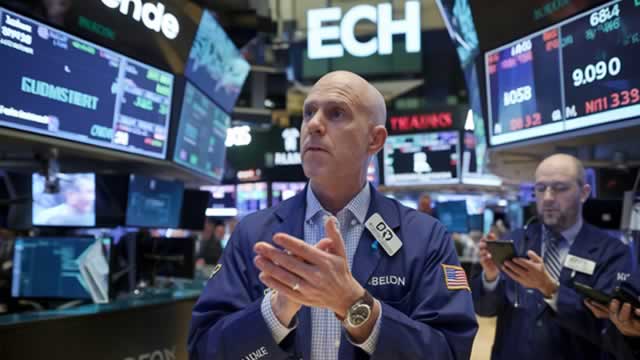
‘Over the medium to longer term, absolutely AI is still the most important dynamic in the market,' said John Belton, portfolio manager at Gabelli Funds.

The Iran-U.S. war exposes the EU's acute vulnerability to energy supply shocks, triggering sharp equity declines and heightened recession risk. EU economies, especially Italy, Germany, and Spain, could face severe inflation due to overwhelming reliance on imported oil and gas.